
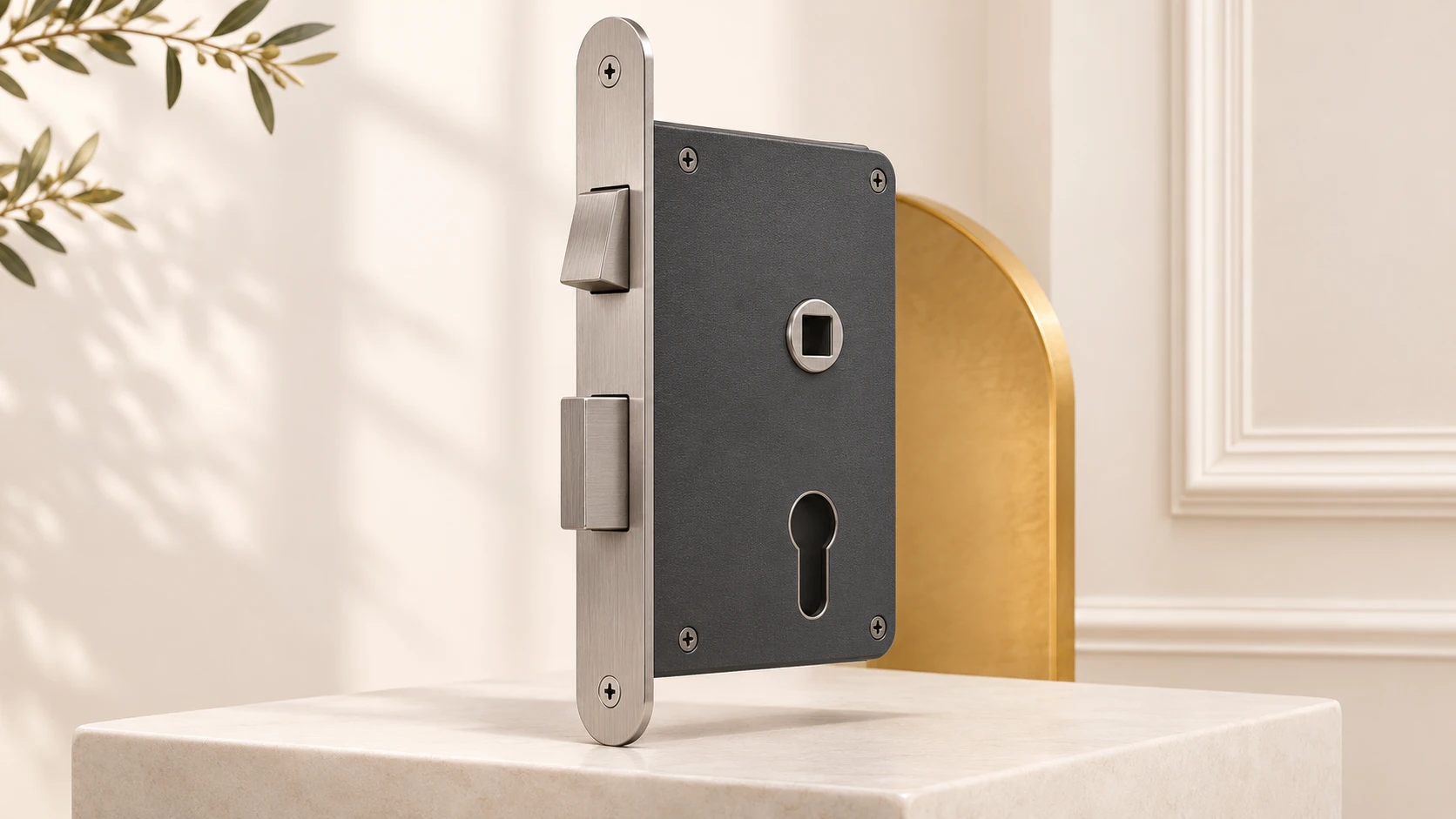
The reference has worn away, the handle no longer returns properly or the mechanism feels stiff: you are looking for a replacement mortise lock. Before comparing prices, prepare a measurement record. Similar-looking models can have different centres, deeper cases or different functions. The aim is to check the complete replacement arrangement, including the handles, cylinder and strike plate you intend to keep.
Describe the problem before choosing a part
Record what happens when the door is used normally. Does the problem involve the handle, the key or the closing action? Does it happen with the door open, closed or both? These observations help direct the checks; they do not establish by themselves that the lock is at fault. Mention any recent impact or change to the door furniture as well.
Take an overall photograph and clear close-ups of the door edge, handles and strike plate. A sufficiently detailed record then gives everyone a useful starting point, without having to repeat the identification process at every exchange.
Identify the relevant components
The case contains the mechanism; the faceplate remains visible on the door edge. The follower receives the handle spindle. The latch holds the door closed, while a deadbolt provides locking where that function is fitted.[EN1][EN6]
Also identify the strike plate on the frame. Keep photographs of these parts together and label the file with the room or door location. In a building with several similar doors, this simple organisation helps prevent measurements from being mixed up.
Record the dimensions that affect replacement
| Measurement | What to record |
|---|---|
| Backset | Distance from the front face of the faceplate to the centre of the handle spindle. |
| Centres | Distance from the handle spindle centre to the cylinder, key or privacy-turn centre. |
| Spindle | Cross-section of the handle spindle and corresponding follower. |
| Faceplate | Length, width, thickness and end shape. |
| Case | Height, depth and thickness. |
| Fixings | Hole positions and screw spacing. |
For an unusual model, use the dimensioned drawing for the relevant reference. Record values in millimetres without rounding them to match a product. A photograph beside a ruler is helpful supporting material, but it does not replace clear written measurements. Mark an uncertain dimension as uncertain instead of presenting it as confirmed.
An illustrative example: you record a 50 mm backset and 70 mm centres. Another model with a 50 mm backset and 72 mm centres will not reproduce the same control positions. Even if both measurements match, the case, spindle, faceplate and fixings still need to be compared.
Keep the function you actually need
Different versions may provide a simple latch, key locking, a bathroom privacy function or provision for a cylinder. Confirm the precise operating function before considering a replacement.[EN2]
Describe the requirement in everyday terms: should the door simply stay closed, lock from inside or be operated with a key? Say whether the handles and cylinder are being retained. This makes it easier to check the interfaces, instead of ordering individual parts before their combination has been assessed.
For a multipoint lock, the survey also needs to cover the position of the locking points and the full faceplate arrangement. Comparing only the central case is insufficient.[EN3]
Confirm handing and any special door requirements
Avoid saying only “left-hand” or “right-hand”. Include a photograph showing the hinges, state which side you are viewing from and whether the door opens towards you. Match this information to the product’s handing convention. Some models are reversible; check their documentation.[EN6]
EN 12209 addresses requirements and testing for mechanical locks and strike plates within its scope. A standards reference does not remove the need to identify the intended application.[EN4]
For a lock certified under the French A2P scheme, follow the configuration specified in the certificate.[EN5]
Mention any fire-door, escape-route or other specialist requirement from the outset. Have the replacement assessed for that particular door before altering its hardware. This information belongs alongside the measurements, even when a new lock appears to fit the existing pocket.
Prepare your ordering record
- Photographs of the door, faceplate, strike plate and operating furniture.
- Any reference numbers or markings that remain legible.
- A dimension table with uncertain values clearly identified.
- The required function, opening direction and parts you intend to retain.
- Special requirements and doorset documentation, where available.
During replacement, follow the instructions for the chosen reference and include checks with the door open before putting it back into service.[EN2]
Keep the ordered reference with your measurements afterwards. For several doors, give each record its own identifier. This makes a later intervention or follow-up enquiry much clearer.
Frequently asked questions
What does “mortise lock” mean?
It describes a lock whose case is fitted into the thickness of the door. The term does not, by itself, specify the dimensions or operating function of a particular model.[EN1]
Do matching centres guarantee compatibility?
No. You also need to check the backset, spindle, case, faceplate, fixings, function and interfaces with any retained components.
Can I keep my existing cylinder?
Ask for its compatibility with the new lock and any certification requirements to be checked. Provide its reference, dimensions and function; do not rely on a photograph alone.
Send Cléferm your measurements and photographs to help prepare the selection of a mortise lock for your door configuration.
Check my selection with CléfermTechnical references
- [EN1] Vocabulaire et choix des serrures
- [EN2] Fiche technique de serrure à mortaiser monopoint
- [EN3] Configuration d’une serrure multipoints à encastrer
- [EN4] NF EN 12209 : Serrures mécaniques et gâches
- [EN5] Certification A2P des serrures de bâtiment
- [EN6] Fiche technique de serrures à encastrer série 200