
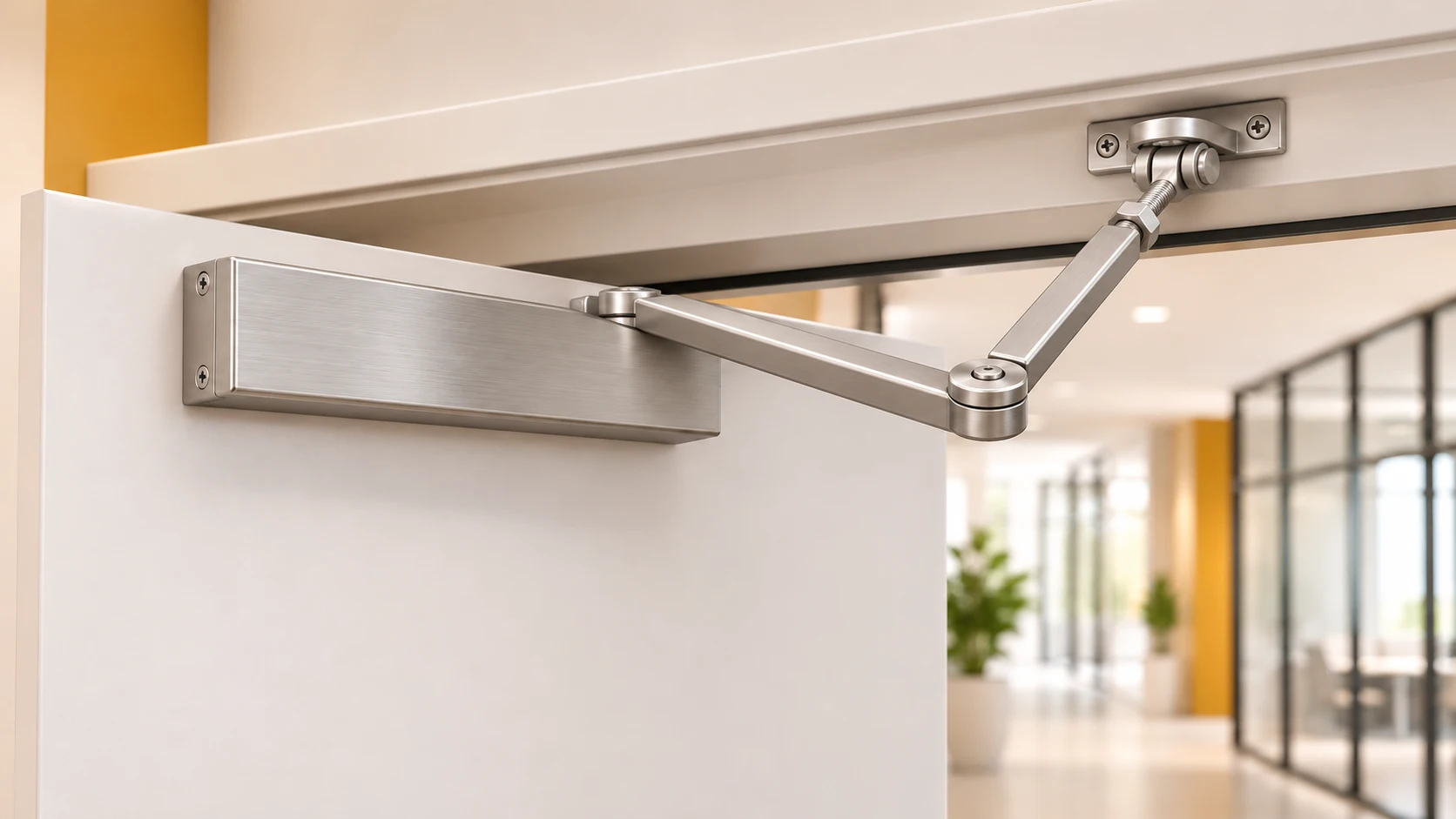
A communal entrance that slams, an office door that stays ajar and a door that has become difficult to open call for different responses. Before buying a closer, describe the problem and the door itself. The right choice should achieve reliable closure while keeping the entrance comfortable to use. Power rating, arm type and mounting options need to be considered together.
Understand what the closer does
A door closer uses the energy supplied during manual opening to return the leaf in a controlled way. EN 1154 covers aspects including the operation and durability of controlled door-closing devices.[FP1]
Give your project an observable goal: the door should return without excessive impact and reach its closed position under normal operating conditions. Describe practical difficulties for users too, such as passing through with a pushchair or trolley.
Record the door details before discussing power
- Leaf width and height, material and weight if known.
- Internal or external location, wind exposure and draughts.
- Frequency of use and particular needs: deliveries, wheelchair users or pushchairs.
- Hinge position and available space on the leaf and frame.
- Lock, seals and any specific requirements applying to the door.
Select EN power size for the door, site conditions and permitted mounting. Follow the model’s specification rather than weight alone, especially where the leaf is exposed to wind.[FP2]
Do not turn missing information into an apparently certain estimate. An overall photograph and a view of the top of the door can support an initial comparison. Any unknown dimensions can then be checked.
Choose the arm and mounting arrangement together
A scissor arm has a visible articulated joint; a slide-channel arm moves along a rail. This affects clearance and appearance, but does not determine the closer’s capacity on its own. Compare complete systems specified for your door.[FP5][FP6]
Confirm the permitted leaf or frame mounting, installation side and accessories. Check the drawings: a similar-looking closer may need different fixing positions or clearances.[FP6]
Distinguish the adjustments that control closing
| Adjustment | What it controls |
|---|---|
| Closing force | The effort available to return the door. |
| Closing speed | The rate of movement through the closing sweep. |
| Latching action | The final part of the movement that completes closure. |
Backcheck slows forceful opening where fitted; it does not replace a suitable door stop. Delayed action extends part of the closing cycle on models that offer it. These functions are not available on every closer.[FP2][FP4]
Before adjustment, have the exact model and its instructions identified. There is no universal number of screw turns for every closer. First record the problem: speed throughout the sweep, final impact, resistance to opening or incomplete closure. This avoids asking for an adjustment that addresses the wrong symptom.
Find the cause of incomplete closure
Misaligned hinges, a binding seal or contact with the floor can obstruct closing. Loose fixings or a fluid leak need checking. Repeatedly increasing the closing force is not a diagnosis.[FP8]
Illustrative example: a consulting-room door returns normally from halfway open but stops just before the strike after a seal has been replaced. A useful report records that sequence of events and the precise stopping point. The technician can inspect the seal contact, lock and final closing adjustment before recommending a new closer.
Plan special requirements as part of the installation
For a fire or smoke-control door, have the closer and accessories checked for compatibility with the doorset. If holding the door open is necessary, use an appropriate solution for that function. A wedge is not such a solution.[FP7]
Some electric hold-open systems release the door in response to a fire signal. Their specification concerns the complete installation, rather than simply adding an arm with a hold-open feature.[FP9]
Check the outcome after the work
- Observe several cycles under the site’s usual operating conditions.
- Check that the leaf returns and closes fully without manual assistance.
- Have the people using the entrance assess the opening effort.
- Keep the product reference, instructions and service provider’s contact details.
- Report any change in behaviour rather than making repeated trial-and-error adjustments.
Frequently asked questions
Will a stronger closer fix a door that does not close properly?
Not always. Have friction, fixings and the installation checked first.[FP8]
Is a slide channel automatically suitable for a heavy door?
No. Check the complete system’s stated capacity and permitted mounting arrangement.[FP5]
Are delayed action and hold-open the same thing?
No. Delayed action slows part of the closing cycle; hold-open retains the door at a specified position.[FP4]
Send Cléferm the known dimensions, an overall photograph and a view of the mounting arrangement, together with the observed fault or intended use. These details will help compare suitable options for your door.
Discuss my door closer with CléfermTechnical references
- [FP1] NF EN 1154 : dispositifs de fermeture de porte avec amortissement
- [FP2] Correctly setting door closers
- [FP3] TS 71 : brochure technique
- [FP4] TS 83 : brochure technique
- [FP5] TS 93 : système de ferme-porte à glissière
- [FP6] TS 83 : ferme-porte à bras compas
- [FP7] NF EN 1155 : dispositifs de retenue électromagnétique pour portes battantes
- [FP8] Door Hardware Operation Manual : product information and safety advice
- [FP9] TS 5000 E : ferme-porte à retenue électrique